

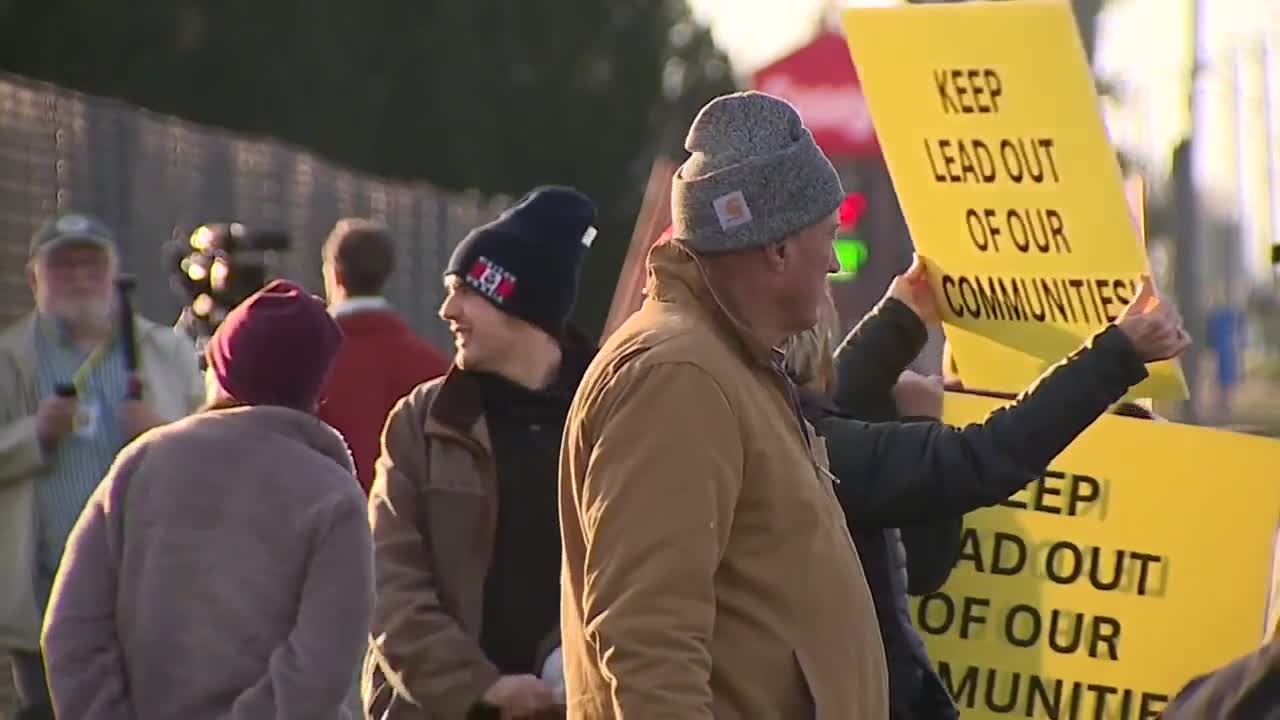



CLARINDA, Iowa — The U.S. Army's plan to detonate roughly 5 tons of lead ammunition in southeast Iowa is on hold after a federal judge stepped in — and for many residents who've voiced their worries, that delay can't come soon enough.
A federal appeals court granted a request from environmental groups to pause a permit that had cleared the way for the Army to detonate several tons of bomb-making chemicals, including dozens of barrels of lead azide. The operation was originally scheduled for Friday, then pushed to Monday, before the court issued its stay.
For health experts, the stakes are hard to overstate.
"The effects of lead on the body, on living things, can be quite detrimental over long-term periods," Naudia McCracken said.
McCracken, the Lead Poisoning Prevention Program supervisor at the Douglas County Health Center, knows the long shadow lead can cast. Just across the state line in Douglas County, Nebraska, most of Omaha proper sits on a lead Superfund site — a community still reckoning with the fallout from smelting and refining operations that shut down 30 years ago.
"I think it does bring up good points for people to remember that this is something ongoing and we still have exposures within our community," McCracken said.
That history is exactly what has southeastern Iowans up in arms over the Army's plan to blow up firearm ammunition containing lead azide.
Lead is known to cause long-term health problems, including neonatal development issues in pregnant women and children, as well as cardiovascular issues among adults. According to the Iowa Environmental Council's 2026 report, Iowa already ranks second in the nation for cancer diagnoses, with potential contributing factors that include pesticides and nitrates in water, PFAS and radon.
Environmental advocates say the Army's approach is a misstep — and they're pushing for a safer path forward.
"Those toxins can end up in our water. That's a concern," Wally Taylor, the legal chair of the Sierra Club Iowa Chapter, said.
"To do it safely, that's the way it should be done," Taylor said.
The Iowa Environmental Council is calling on state leaders to take a more active role.
"We are calling on our state leaders, including Governor Kim Reynolds, to take control of the communications of any potential detonation," Michael Schmidt, general counsel for the Iowa Environmental Council, said.
Gov. Reynolds issued a statement saying, in part, that she's "grateful" for the delay.
"Earlier today, I spoke with Acting Secretary of the Army Adam Telle and asked him to delay the planned detonation at the Iowa Army Ammunition Plant. I'm grateful for his decision to do so," Reynolds said.
In another statement made Friday night, Reynolds confirmed she has activated the "State Emergency Operations Center (SEOC) to coordinate state agencies in advance of the U.S. Army’s planned detonation at the Iowa Army Ammunition Plant."
I have activated the State Emergency Operations Center (SEOC) to coordinate state agencies in advance of the U.S. Army’s planned detonation at the Iowa Army Ammunition Plant in Middletown, Iowa. My office and state agencies are actively coordinating with federal officials from the Environmental Protection Agency and Army to continuously monitor the situation and keep local partners informed.
— Gov. Kim Reynolds (@IAGovernor) November 21, 2026
Governor-elect Rob Sand also weighed in on social media. "The public deserves to know, if this is the safest option, why other options were worse," Sand said.
The safety of Iowans now and in the future should be government’s top concern. An unacceptable lack of communication and clarity has made Iowans understandably concerned and angry about this situation. The public deserves to know, if this is the safest option, why other options were worse. If it isn’t as safe as possible to do this tomorrow, it shouldn’t happen tomorrow. https://t.co/wGsUjYTFh2
— Rob Sand (@RobSandIA) November 19, 2026
The delay followed an outpouring of public concern.
According to the Associated Press, Acting Army Secretary Adam Telle said the move would "delay the detonation until the latest possible moment prior to a forecast temperature drop, which would risk further destabilization of the material."
The Associated Press reported that Army officials contend the chemicals are unstable, and the risk of an uncontrolled explosion is growing, particularly as temperatures drop. In March, staff at the Iowa Army Ammunition Plant found several dozen barrels of degraded lead azide, and crystallization of the material created an unstable and dangerous situation.
Environmental groups disagree, arguing in their petition that other alternatives were not fully considered and criticizing officials for not sharing more information with the public. The Army detailed its plans during a public meeting in Middletown in October, but a public advisory Sunday was the first time some communities — some as far away as 100 miles — became aware of the potential impact.
For those in the path of a potential plume, experts advise paying close attention to official warnings.
"Definitely take advantage of those advisories that come out, take those seriously. If they're saying you need to evacuate or clean properly, definitely do that," McCracken said.
McCracken recommends listening to Army, EPA and health official advisories, taking advantage of follow-up testing — which is normally free — and practicing proper cleaning, like leaving shoes at the door to avoid tracking anything inside. She said pregnant women and children should get tested, noting insurance usually covers it.
Watch for Ryan Gamboa's reporting on 3 News Now and 3NewsNow.com. Have a story idea or tip for Ryan? Email him.

 Facebook
 YouTube
 Instagram
 X
This story was initially reported by a journalist and has been converted to this platform with the assistance of AI. Our editorial team verifies all reporting on all platforms for fairness and accuracy.
